Customers no longer want to install another app. They want to send a message and get an answer, with the same personal service they would get from a business they know. Commerce and customer service are moving into the conversation, and the companies that connect that conversation to their real systems will be the ones that benefit.
I look at my phone: Gmail, 188 unread emails. WhatsApp, zero.
Not because I get fewer WhatsApp messages, but because I answer them right away. Email waits until I have time. WhatsApp I open anyway, dozens of times a day, especially because it's where my wife, my parents or my daughter can write to me at any moment.
I am not the only one. At Meta's WhatsApp Business Summit EMEA 2026, Elie Antoun, who leads Meta's enterprise sales specialists in EMEA, shared his own numbers: over 100 unread messages on WhatsApp, over 600 unread SMS and over 5,000 unread emails. "Draw your own conclusions about which channel works better."
Why don't customers want to install apps anymore?
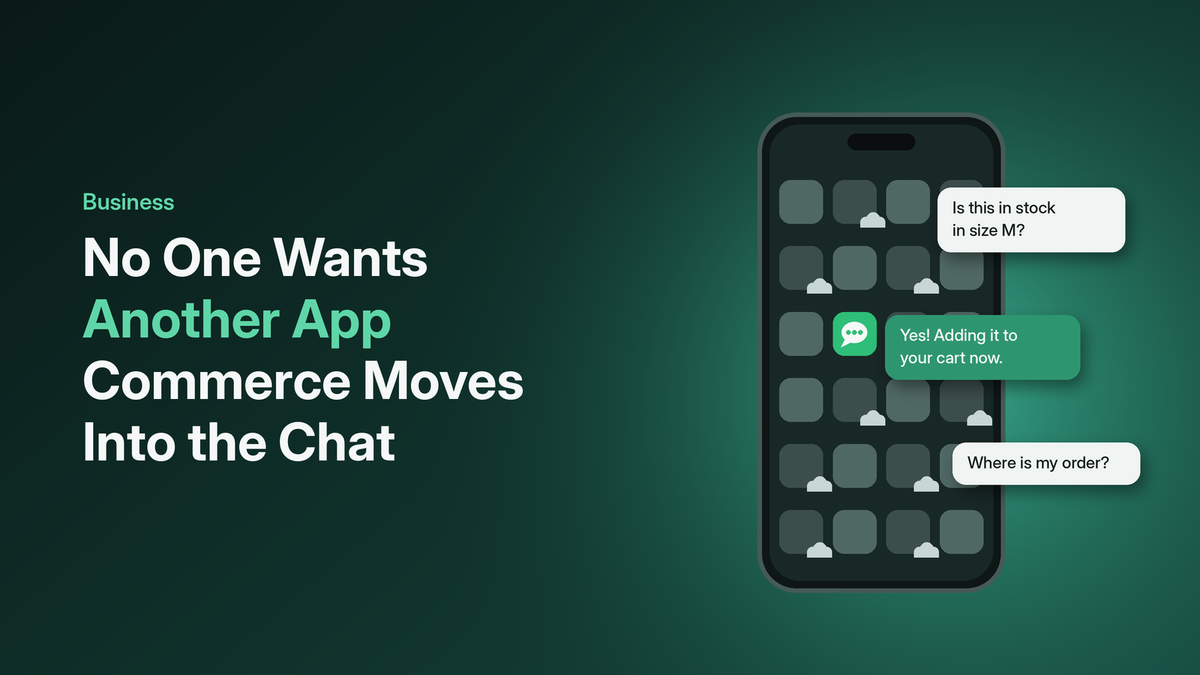
How many business apps are on your phone? Food, fashion, airlines, banks, couriers, healthcare providers. Probably dozens. How many do you open in a month? A handful. On my iPhone, about 35% of my apps are already offloaded: the icon is still there, with a small cloud next to it, but the app itself is gone. Every time I need one of them, once in a while, I have to wait for it to download again. It's a small thing, but it's frustrating.
Every app means a download, a new account, a password and notifications you switch off after a week. It also takes up storage, and when the phone runs out of space, the apps you rarely use are the first to go. For a customer who buys from you twice a year, your app will be among the first to be deleted, and from that moment your notifications no longer reach them. Installing your app makes no sense to them.
Messaging works differently. It is already installed and already open. According to Meta, people open WhatsApp around 30 times a day on average. There is no new account, no password and no habit of leaving messages unread.
The numbers Meta presented in 2026 point the same way:
- 75% of people would rather message a business than call it, email it or visit its website.
- 71% of online adults are more likely to buy from a business they can message directly.
When a customer wants something, they no longer browse menus and filters. They don't have the time, and they don't want to spend it learning how your website works. Ideally, they want to send a quick voice message while driving or standing in the checkout queue at the supermarket. They ask.
Why aren't aggregators the answer?
Marketplaces and aggregators tried to solve app fatigue: one app for hundreds of restaurants, shops or suppliers. Convenient for the customer. Less so for the business.
On an aggregator, the customer is no longer yours. They belong to the platform. When something goes wrong, they talk to a support team that knows nothing about your business or their history with you. The experience is the same for everyone, and the data and the relationship stay with the platform.
It goes further: you don't control the community. Your relationship with customers depends on the platform's terms and fees. Many businesses stay on an aggregator even when it no longer makes financial sense, because that is where their reviews, content and audience live. All of it belongs to the platform.
Even the largest brands have reached this conclusion. In 2019, Nike stopped selling directly on Amazon, saying it wanted to focus on "more direct, personal relationships" with consumers.
People don't want another app, but they don't want a generic experience either. They want what they get when they deal with a business they know: it recognises them, sees their orders and solves what they need.
What is conversational commerce?
Conversational commerce means buying, asking questions and resolving issues through a conversation instead of menus, filters and forms. The customer writes a message, sends a photo or a voice note, and the business answers and takes action in the chat: it finds the product, checks stock, sends a payment link, reschedules a delivery or an appointment.
The idea isn't new. What's new is that AI agents can now hold these conversations at scale, using live data from the company's own systems, at any hour. Meta put it plainly at its 2026 summit: "the chat is becoming your new storefront."
An agent is not the chatbot many companies switched off a few years ago. An agent combines four layers: knowledge (your catalog, policies and FAQs), skills (what it is allowed to do and when to hand over to a person), tools (integrations that let it act in your systems) and the underlying model. "Anything shorter than that is a chatbot."
Who is already doing it?
This is no longer an experiment. Large companies across industries have moved key parts of the customer journey into messaging, and they report measurable results.
- Delivery Hero (food delivery) built a proactive AI agent on WhatsApp that advises its restaurant partners on campaigns, menus and customer feedback. Restaurants using it grew orders by more than 15%, and 40,000 partners are already live.
- Renault Turkey (automotive) launched a WhatsApp assistant that answers instantly and hands over to a person when needed. Response times dropped by 93%, issues were resolved 35% faster, and 4% of WhatsApp leads turned into sales.
- Lenovo Indonesia (electronics) lets customers book and manage repair appointments inside WhatsApp, with 8.2 times higher conversion to bookings.
- Air France (travel) runs offers, travel updates, support and login codes in a single channel. Its WhatsApp offers get 4.5 times more clicks than email, and 85% of its social customer care now happens on WhatsApp.
- eMAG (e-commerce, Romania) launched iZi, an AI shopping assistant that works with real stock, prices and delivery times. In its first six months it helped more than 900,000 people and assisted over 100 million lei in sales.
- OLX Group (marketplaces) built DealFinder, a buyer assistant on WhatsApp that searches by text, photo or voice. In a 2,000-user beta in Portugal, 18% of contacts converted.
Sources: case studies presented by Meta at the WhatsApp Business Summit EMEA 2026; eMAG and OLX as linked.
Delivery Hero's choice of channel is telling. The company had its own platforms, but chose WhatsApp because "we wanted to be where the restaurants already were." And eMAG's data shows when customers need help: most conversations happen between 8 PM and 11 PM, and around 6% between midnight and 6 AM, when no one is at the office.
Why is integration harder than the chat itself?
Putting a chat window in front of customers is easy. Making it useful is not. A conversation only creates value when the agent can see and act on the same data your team uses: orders in the ERP, customer history in the CRM, stock and shipments in the WMS, appointments in the scheduling or patient system.
Without that, you get a polite FAQ that guesses from documents. With it, a customer can ask "Where is my delivery?" and get the real status, change the delivery window, or reschedule an appointment, all in one thread.
For enterprises, this is where most of the work sits:
- Connecting existing systems such as SAP, Salesforce, warehouse and transport systems, or healthcare platforms, through APIs and middleware, without rebuilding them.
- Defining what the agent may do: which actions it can take, which require customer confirmation and when it hands the conversation to a person with full context.
- Data protection and compliance. In Europe, legal and GDPR questions are often the first blocker. Meta's own country director for DACH said that in every case so far, the blockers could be removed once the right experts were involved.
- Keeping control of your data. Meta states that with its business agent platform "your data stays yours, and your conversations will not train our AI." Whatever provider you choose, ask for the same commitment in writing.
The chat is the visible part. The integration behind it is what turns it into a sales and service channel.
Where should you start with conversational commerce?
Meta's advice to enterprises was simple: "Pick the boring use case." Take a message you already send, such as an order update, a delivery window, an appointment reminder or a login code, and move it to messaging. It is the message customers actually want, and it opens a conversation you couldn't have had otherwise.
What that looks like by industry:
- Logistics and supply chain: shipment status, delivery slots and rescheduling, proof of delivery, exception alerts, answered from live data in the WMS or TMS instead of a call centre.
- Healthcare and MedTech: appointment booking and reminders, preparation instructions, rescheduling and follow-ups, with clear rules on what the agent may handle and when a person takes over.
- Retail and e-commerce: stock and size questions, product search from a photo, order status, returns and payment links in the chat.
- B2B and distribution: order status, invoices, price and availability checks for dealers and partners, the kind of questions account managers answer all day.
We have already seen this work in practice. For Prow, a tech event in Timișoara, our WhatsApp agent answered more than 74% of participants' questions on its own, leaving the team free for the conversations that needed a person. For an online store selling car parts, the agent handles the entire buying process: it answers basic questions, recommends the right parts and sends the payment link, all in the same chat.
Start with one use case, connect it to the system that holds the answer, measure it, then expand. Keep the app, keep the website and stop assuming they're the only doors.
What if the next app your customers use is the one they already have?
Your website and your app aren't going away. But questions, sales and service are moving into the conversation, and the largest companies are already building for it. McKinsey, in research cited by Meta, expects agentic commerce to drive 3 to 5 trillion dollars in transactions by 2030.
The winners won't be the companies with the cleverest chatbot. They will be the ones whose conversations are connected to real data and real processes, so that every message can end in an answer or an action.
At Webamboos, this is the kind of integration work we have done for more than ten years: connecting ERP, CRM, WMS and healthcare systems for clients in logistics, MedTech and enterprise across Europe, the US and Australia. If you are exploring how to bring your customer journey into messaging, let's talk.