In Europe, WhatsApp isn't just an app we have on the phone. It's the app we use for almost everything.
The numbers say it clearly. In Spain, around 91% of internet users are on WhatsApp. In Portugal and Ireland it's over 90%, and in Italy it's close to 90% too (Statista, Q3 2024). In Germany, about 8 in 10 people use it (source). In the UK there are around 30 million users, and most of them open it every single day.
Now look at the US. There, WhatsApp reaches only about a third of internet users — roughly 100 million people (source). Most conversations there still happen over iMessage or plain text messages. Globally WhatsApp passed 3 billion users in 2025, but in Europe it's simply different: here it's the default, not the backup.
So it makes sense that tools built on top of WhatsApp often feel like they were made for us, here. Because everyone talks on WhatsApp, businesses followed. That's how it usually works. You go where the people already are.
A few years ago, every ecommerce shop and every marketplace had a little web chat box in the corner of their website. You'd type your question and wait. And here's the annoying part: if the answer didn't come fast, you closed the tab. Then you never got the answer. The whole conversation was just gone.
WhatsApp doesn't have that problem. It's always on your phone. If the reply comes two hours later, you still see it. It's still there. And the whole history stays with you and you can scroll back to what you asked last week. If a new question pops into your head, you just take your phone, type it in the same chat, like you would with a friend. No starting over, no explaining everything again. That sounds like a small thing, but it changes the experience and how people talk to a shop.
Now most of them have moved from web chat to WhatsApp.
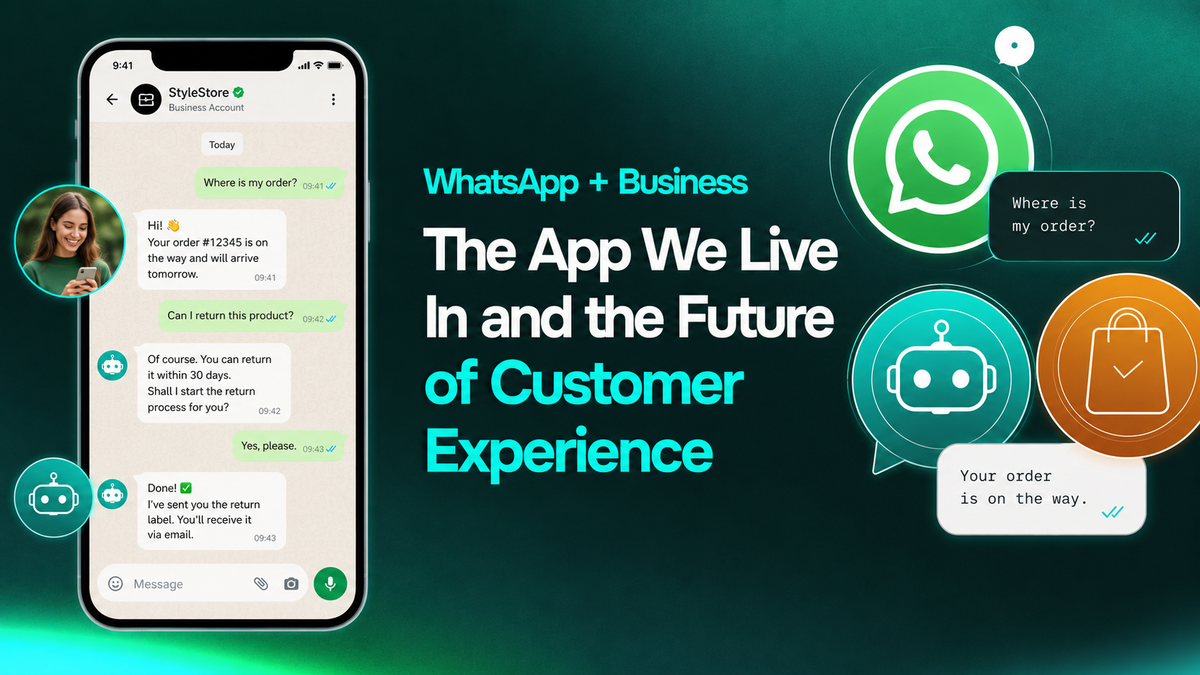
Then something else happened. Companies that wanted to offer their clients a more premium experience started putting a bot inside the chat. Not a person typing on the other side, but a bot trained on their own data. It doesn't only answer questions, it actually does things. "Where is my order?" "I want to return this product." "Find me a worker available tomorrow, up to 100€." You ask, and it happens, right there in the conversation. No waiting for a human, no support ticket. The bot sees your phone number, finds you in the CRM, and already knows who you are, so no need to identify yourself, share an order number, or repeat any details.
For a long time, many businesses were actually afraid of WhatsApp. The worry was simple: people will write a lot, and if nobody answers fast, the client leaves with a bad experience. So they stayed away. But a bot changes that. Trained just on your own data, it can answer as many questions as people send, at any hour, without getting tired. And it's cheap. What used to be the reason not to use WhatsApp is now the reason to use it.
There are a lot of predictions that in a few years we won't really buy from ecommerce websites anymore. Instead, we'll ask an agent, and the agent will buy for us. Morgan Stanley expects nearly half of online shoppers to use AI shopping agents by 2030 (source). WhatsApp feels like the first step in that direction.
And honestly, it's kind of nice. Writing to a shop the way you write to a friend - "hey, what would you recommend?" - getting a real answer, and confirming the order right there. No forms, no clicking through five pages, no human needed on the other side.
The last thing we noticed is maybe the most surprising one. Even big enterprise companies are moving to WhatsApp now. Slower, yes. With more rules, more restrictions, more caution. But they're moving. Because if you want to sell, you have to be where your customers are.
What about your customers? Are they on WhatsApp?